Reviewed by Yoan Guyon, Managing Director at gbc engineers
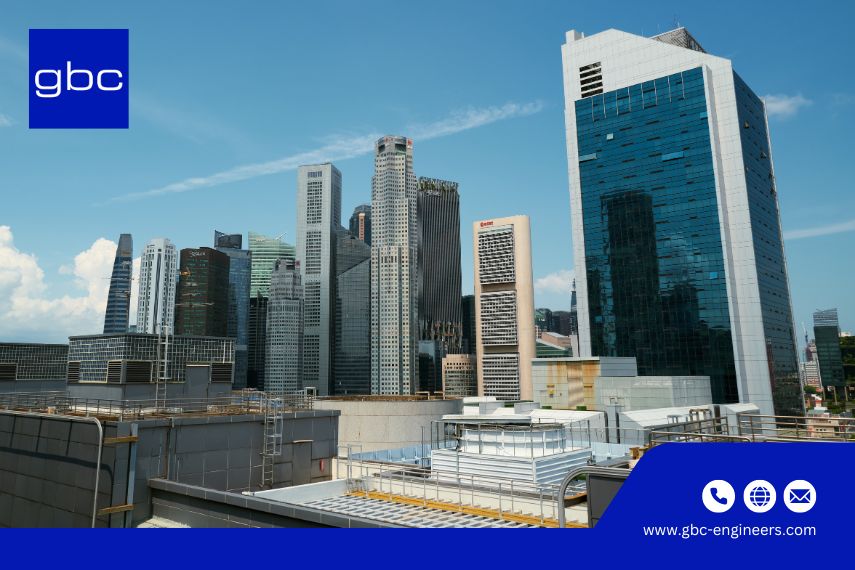
In 2019, one of the world's most attractive data center markets simply stopped taking new projects. Singapore, a hub that operators had spent a decade building up, quietly paused new data center approvals.
Singapore's data center demand was on track to outgrow what its land, power grid and water supply could sustainably support, and water scarcity was one of the clearest limits driving that decision.
For gbc engineers, the case is a useful reminder that resource constraints are not an emerging-market problem. They can stop a mature, high-demand market cold.
Why data center demand collided with sustainability limits
Singapore's rise as a data center hub was not an accident. Connectivity, political stability and a central position in Southeast Asia made it the default landing point for capacity across the region.
By the late 2010s, demand for new facilities was growing faster than almost anywhere else in Asia Pacific. But Singapore's underlying resources did not scale the same way.
The country has no natural lakes or rivers of any real size. It depends on local catchment (rainwater collected in reservoirs), imported water, reclamation and desalination just to meet everyday demand. That is before a single data center draws a liter.
Land is finite too. The island covers just 730 km². The power grid was already absorbing a steep rise in industrial and digital demand.
Regulators framed the pause around 3 pressures. They wanted to prevent unmanaged growth from exhausting resources. They wanted to raise efficiency standards before approving more capacity. And they wanted to protect the power grid from outdated facilities.
Read more: Data Center Water Use: Sustainable Cooling Design
The "Four National Taps" limit that shaped the decision
Singapore's water supply comes from 4 sources known locally as the Four National Taps: local catchment, imported water, reclaimed water (NEWater) and desalination.
Current national demand runs at about 1.6 million m³ a day. The table below shows the maximum share each source can contribute, not simultaneous shares of one total.
National demand is projected to nearly double by 2060. Data centers draw on that same stretched system. Regulators capped data center growth to protect it. Without that cap, the system risked running short of water years before 2060.
|
Water source
|
Contribution potential
|
Constraint
|
|
Local catchment (rainwater)
|
Up to around 70% (roughly 1.1 million m³)
|
Rainfall-dependent, land-limited
|
|
Imported (Johor)
|
Up to around 50%
|
Capped by treaty, expires 2061
|
|
NEWater (reclaimed)
|
Up to 40%
|
Requires treatment infrastructure
|
|
Desalination
|
Up to roughly 25-30%
|
Energy-intensive, costly to scale
|
Read more: Why data center construction projects go over budget
What other water-constrained markets can take from this
Singapore is an extreme case, but the tension is not unique to it. Any market where data center growth outpaces water infrastructure is heading toward the same conversation.
A facility's water strategy cannot be decided on its own, separate from the region's water plan. A cooling system that works on paper for one data hall can be the wrong choice for the wider market. Every operator there draws on the same limited supply.
Singapore's government eventually reopened new capacity, but only through a structured application process. Reports indicate that process came with some of the strictest efficiency requirements set anywhere.
Read more: The Complete Guide to Data Center Cooling
The structural angle in water-constrained builds
Where water scarcity pushes a market toward closed-loop or seawater cooling instead of evaporative towers, the structural consequences shift too.
Seawater cooling intakes need dedicated structural bays and corrosion-resistant detailing that a standard plant room was never designed around.
In water-constrained markets, the cooling strategy is no longer a late-stage MEP decision. It gets set at concept stage alongside the structural plan.
What developers should check before entering a water-constrained market
- Confirm the region's water supply plan, not just current availability. A market with adequate water today can still be planning a multi-decade shift.
- Model WUE against the market's efficiency benchmarks, not a global average. A design that passes in a water-abundant region may not clear the bar in a constrained one.
- Plan for closed-loop or reclaimed cooling from concept stage if the market signals water sensitivity. Retrofitting after approval is far more disruptive.
- Treat regulatory approval timelines as a resource question, not just a paperwork one. Bottlenecks can appear with limited warning when demand runs ahead of infrastructure.
Conclusion
Singapore's pause was resolved, not permanent. New capacity is now moving forward under a much stricter sustainability bar than existed before 2019.
For developers, the takeaway is to treat water and energy limits as a planning input from the earliest site-selection conversation. gbc engineers works with project teams to keep the structural strategy in step.
Frequently asked questions
What is the Four National Taps strategy in Singapore?
It is Singapore's national water security framework, built on 4 sources: local catchment (rainwater collected in reservoirs), imported water, reclaimed water (NEWater) and desalination.
Why did Singapore place a moratorium on new data centers?
Singapore paused new approvals in 2019 because demand was growing faster than the land, power grid and water supply could sustainably support.
How much of Singapore's water supply is reclaimed (NEWater)?
NEWater can currently meet up to 40% of Singapore's water demand, with national planning targeting a much higher share by 2060.
Is Singapore's water supply considered scarce?
Yes. Singapore lacks natural freshwater sources like large rivers or lakes and depends on imported water, reclamation and desalination for a large share of supply.
Are new data centers still being approved in Singapore?
Yes. Since 2022, new capacity has been released through a structured application process with some of the strictest sustainability requirements applied to data centers globally.
|
About us
gbc engineers
is an international engineering consultancy with offices in Germany, Poland, and South East Asia, having delivered 500+ projects worldwide. We provide services in structural engineering, data center design, infrastructure and bridge engineering, BIM & Scan-to-BIM, and construction management. Combining German engineering quality with international expertise, we achieve sustainable, safe, and efficient solutions for our clients.
|