For decades, every industrial investor and project manager has faced the same billion-dollar question: Speed or Durability?
It used to be a binary choice. If you needed a facility operational within six months to meet market demand, you chose steel. If you needed a structure to withstand massive vibrating machinery, fire risks, and humid environments for fifty years, you chose reinforced concrete. But in today’s hyper-competitive manufacturing landscape, compromising on either metric is no longer an option.
This demand for "no-compromise" performance has given rise to the modern gold standard in industrial engineering: Steel Concrete Structure Design for Factories. By leveraging Hybrid Systems, engineers are finally delivering the best of both worlds.
At gbc engineers, we have observed this shift firsthand. Bringing German engineering precision to the booming industrial sectors of Southeast Asia, we see that the factories of the future are not built of steel or concrete. They are built of both.
The Traditional Dilemma: Steel vs. Concrete
To understand why hybrid systems are revolutionizing the industry, we must first look at the limitations of relying on a single material. When designing a new manufacturing plant, the "pure" options each come with significant trade-offs.
The Case for Steel
Steel structure design for manufacturing plants is the traditional go-to for logistics hubs and warehouses.
Pros
It is incredibly fast to erect. The lightweight nature of steel reduces the load on foundations, saving costs on ground preparation. It also allows for massive clear spans, which are essential for crane operations.
Cons
The Achilles' heel of steel is fire resistance. Achieving necessary safety ratings requires expensive intumescent coatings. Furthermore, in humid tropical climates like Vietnam, corrosion is a silent killer, driving up long-term maintenance costs.
The Case for Concrete
Reinforced concrete design for factories remains the standard for heavy industry.
Pros
It offers superior fire resistance and inherent mass. This mass provides vibration dampening, which is non-negotiable for facilities housing precision electronics or heavy stamping machinery.
Cons
It is slow. Curing times cannot be rushed without compromising integrity. Additionally, the sheer weight (dead load) requires massive, costly foundation systems.
Neither material alone perfectly solves the equation for modern industrial load calculations or complex seismic design for industrial buildings. A pure steel building vibrates too much for high-tech assembly; a pure concrete building takes too long to deploy for a rapid-market entry.
Why Hybrid Systems Win: The Technical Advantage
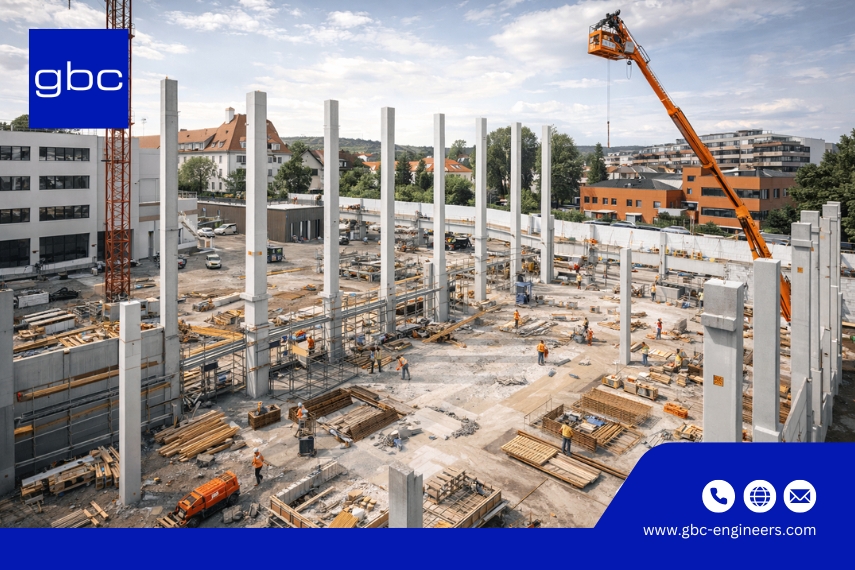
A "Steel Concrete Structure" (Hybrid) in an industrial context is not simply mixing materials; it is the strategic allocation of material properties. Typically, this involves using precast reinforced concrete for columns to provide stiffness and compressive strength, paired with steel trusses for roof structures to span long distances with minimal weight.
Here is why this approach is winning:
Optimized Load Calculations & Efficiency
Hybrid designs follow the path of forces. We use concrete where we need to handle heavy vertical compression (columns and foundations) and steel where we need to handle tension and span (roofs and upper floor framing).
Result: We reduce material waste significantly. The structure becomes lighter than a pure concrete building but stiffer than a pure steel building. This optimization of industrial load calculations directly translates to cost savings in the foundation phase.
Speed + Durability (The "Tesla" Effect)
.png)
Speed is the currency of modern manufacturing. By utilizing precast concrete elements combined with steel framing, projects can see a reduction in construction time by up to 30% compared to cast-in-place concrete.
This methodology is visible in the construction of modern "Gigafactories," such as the TESLA Gigafactory Berlin-Brandenburg, where gbc engineers contributed expertise. These projects utilize advanced structural strategies to meet aggressive deadlines without sacrificing the lifecycle durability of the asset.
Seismic & Vibration Control
For industries like semiconductor manufacturing or heavy robotics, vibration control is critical. A hybrid system handles seismic design for industrial buildings by balancing flexibility with stiffness. The concrete columns absorb and dampen machine vibrations, preventing them from transferring to the steel roof or other sensitive equipment.
gbc engineers: Mastering the Hybrid Approach
Implementing a hybrid system requires more than just buying steel and pouring concrete. It requires a "German Quality, Local Expertise" approach to ensure the interfaces between these two different materials function as a single, cohesive unit.
At gbc engineers, we do not just design; we optimize using Building Information Modeling (BIM).
BIM Structural Engineering: The intersection of steel and concrete is where errors usually happen. We use BIM to detect clashes and model connection tolerances before a single beam is fabricated. This ensures that a steel truss manufactured off-site fits perfectly onto a concrete column cast on-site.
Precast Concrete Design: We specialize in customizing precast solutions that integrate seamlessly with steel frames. This is a capability we have refined through complex Data Center projects, where speed and structural rigidity are paramount.
The importance of this precision cannot be overstated. As detailed in our recent update on Structural Engineering Quality: From Design Approval to Supervision, the accuracy of the design phase is the primary factor in preventing costly delays on site. A well-planned hybrid design eliminates the "adjustment time" usually needed to force ill-fitting components together.
Beyond Design: The Importance of Lifecycle Management
A factory is not finished when the construction crew leaves. It is a living asset that undergoes stress every day.
Because hybrid structures rely on critical connections between dissimilar materials, structural inspection for infrastructure becomes a vital part of the facility's lifecycle. Steel-to-concrete joints are stress points that must be monitored.
- Vibration Fatigue: Over time, crane loads and machine operation can loosen connections.
- Environmental Impact: Ensuring the interface remains sealed against moisture prevents corrosion at the joint.
gbc engineers offers end-to-end services. We do not just provide the initial factory structural design services; we stay partners in the asset's longevity through technical due diligence and inspection of existing infrastructure.
Conclusion
Hybrid steel-concrete designs are no longer just an "option" or an "alternative." They are the winning strategy for modern, efficient, and durable factories. They allow investors to hit their operational dates sooner while ensuring the facility can withstand the rigors of heavy industrial use for decades.
Do not compromise between speed and quality. Partner with gbc engineers to leverage German engineering precision for your next industrial project.
|
About us
gbc engineers
is an international engineering consultancy with offices in Germany, Poland, and Vietnam, having delivered 10,000+ projects worldwide. We provide services in structural engineering, data center design, infrastructure and bridge engineering, BIM & Scan-to-BIM, and construction management. Combining German engineering quality with international expertise, we achieve sustainable, safe, and efficient solutions for our clients.
|